SIGHTEC’s Innovative Solutions
SIGHTEC addresses this critical issue with two advanced residual ink handling methodologies:
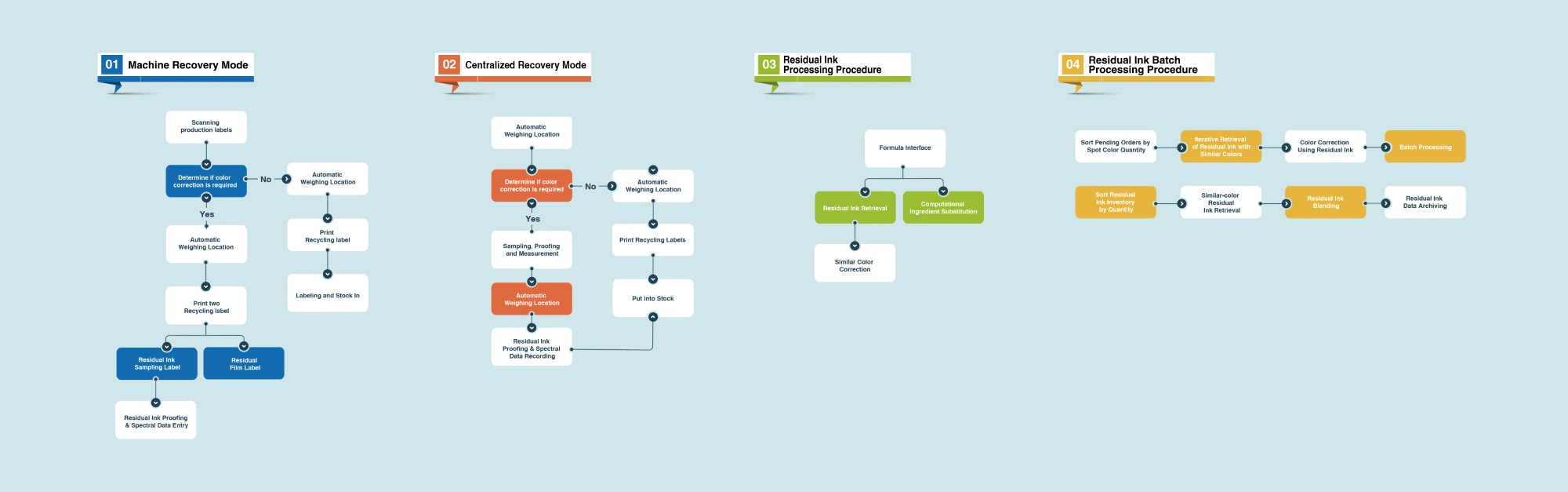
Ⅰ. Computational Recycling
Process of Computational Recycling:
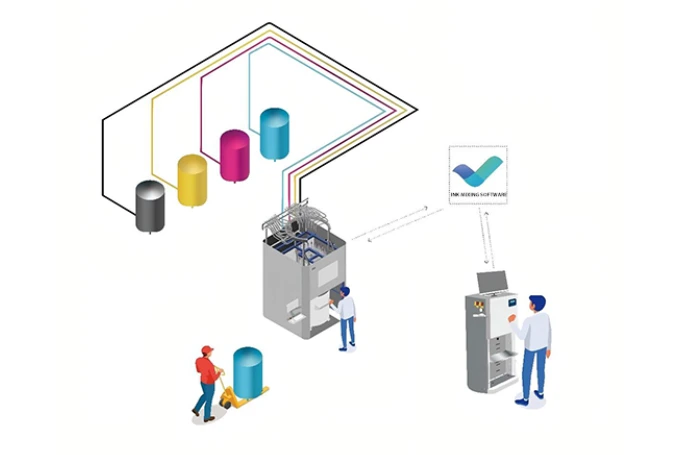
- Calculates and compares the ingredients of the residual ink formula and the required ink formula.
- Race the batch in the residual ink bank and race out the residual ink that can be used.
- The system then calculates the precise amount of additional ink components needed to blend the residual ink into the target formula.
Advantage of Computational Recycling: Streamlined and time-efficient processing
Disadvantage of Computational Recycling: Cannot utilize residual ink batches that are a similar color but have a mismatched formula, potentially leaving usable material unprocessed.
Ⅱ. Spectral Matching & Color Correction (Overcoming Computational Limitations)
Process of Spectral Matching & Color Correction
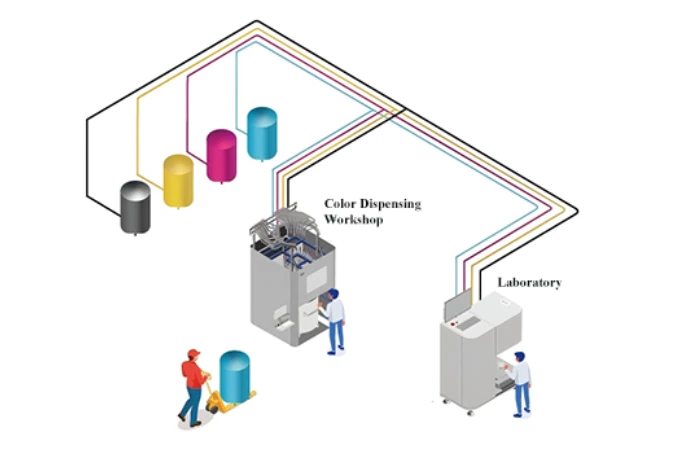
The full spectral data (reflecting the color characteristics) of all residual ink batches is stored in the inventory database.
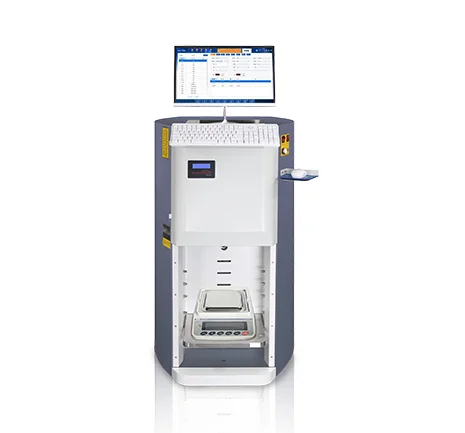
A spectrophotometer measures the spectral data of the required target color.
The system performs a batch search within the residual ink inventory, finding all batches closest in spectral match to the target color – regardless of their original formula.
SIGHTEC’s color matching software automatically performs color correction calculations on the selected residual ink batches to achieve the precise target color.
Advantage of Spectral Matching & Color Correction
This process enables the efficient and automated reuse of a much wider range of residual inks, including those with similar colors but different formulas.